

Recently I made crispy roast pork belly, a classic Cantonese dish, for a potluck. There have been a few requests for the recipe, which I will include below, but first I would like to talk about animal welfare in meat farming.
I went to the local Asian market for this dish’s ingredients. Interestingly, there is now a sizable selection of organic beef options and hormone- and antibiotic-free pork cuts at this shop. When I began working in the grocery industry a few years ago, the “broad stroke” wisdom was that new immigrants in Canada tend to be more budget-conscious and are therefore less likely to seek out meat products that emphasized animal or environmental welfare during production. Obviously Canada has since evolved; while there are still consumers – immigrant or otherwise – whose top shopping criteria is price, there is a growing segment that demands sustainably farmed meats. Offering these products is beyond just putting lipstick on a pig to make food companies look good. It’s a way to provide options and educate the consumer to think about how food production affects animal welfare, food safety, and environmental conditions.
In the last half century, the global demand for meat has skyrocketed. Let’s use pork as an example to keep with today’s theme. American hog farmers went from producing 12.1 billion pounds of pork in 1959 to 22.8 billion pounds in 2009. While some have taken painstaking efforts to maintain good stewardship, others have achieved such high volumes at the expense of animal welfare. Imagine being strapped to an economy class airplane seat, surrounded by angry neighbours with the worst BO, and being fed tasteless airline food that makes you bigger and bigger as you approach your destination. Now imagine spending your whole life this way. Such is the cruel reality of some extreme intense indoor pig farming practices: animals are raised entirely in gestation crates so small that they cannot properly lie down, and the confined space has led to pressure sores, infections, and tremendous mental suffering. To combat these ailments and to boost muscle growth, many farmers treat the hogs with heavy doses of antibiotics and growth hormones.
In developed countries, antibiotics have been widely used in agriculture since at least the 1950s. This class of drugs helps to fight specific infections in livestock and reduce the chances of them spreading through the herd. While there have not been documented cases of antibiotics used in animal feeds directly harming humans, the concern is that bacteria develop resistance over generations: the “strong” pathogenic bacteria that survived a round of antibiotics treatment are the only ones that survive to breed; their genes are passed on, creating subsequent generations of bacteria that are not harmed by antimicrobial drugs. The result is that over time, more drugs or stronger ones are needed to control the same diseases.
There is a general and somewhat misguided concern that “meats are pumped full of hormones.” In Canada, hormone growth promoters are not permitted in raising pigs (nor in milk cows or chickens; it is only used in beef cattle). However, ractopamine is a frequently used feed additive. When fed to livestock, the controversial chemical, banned as animal food in some 160 countries, stimulates muscle fibre growth, which yields lean meat that is worth more on the market than pork fat. However, the use of ractopamine has also been linked to increases in trembling, hyperactivity, broken limbs, inability to walk, and even death in pigs. While it is metabolized fairly quickly by hogs, there is often still traces of ractopamine in pork, and the European Food Safety Authority has opined that currently available data is insufficient to determine the safe maximum residue limit for human consumption. It has been suggested that the consumption of meat containing ractopamine could lead to tachycardia, tremors, muscle spasm, or high arterial blood pressure in humans.
Recognizing the risks associated with industrial pork farming, some producers have adopted more humane practices. The UK has banned the use of farrowing crates and sow stalls to give animals more room to move. Some Canadian farmers have switched from the cheaper Dried Distiller Grains with Solubles (DDGS), a byproduct of corn ethanol production, to barley- or and pea-based feeds that yield more flavourful pork. Some have completely remove ractopamine in pig feed. Others have set goals to limit antibiotic use. Nonetheless, even the more sustainable pig farming methods are not without their controversies. Docking – the removal of a piglet’s tail within hours of birth – is a common way to prevent the animal from having its tail bitten off by other pigs during normal interaction, which could lead to severe pain, infection, and abscesses. Teeth clipping or grinding – the blunting the needle teeth a piglet – reduces facial wounds to itself and udder lacerations to its sow, but sometimes at the expense of gum and tongue injuries to the clipped pig. Nose-ringing – the clipping of metal rings to the nose of an outdoor hog – makes the normal act of a pig rooting through the ground with its snout uncomfortable, but reduces its chances of contracting parasites and infections.
Responsible pig farming in a world of increasing meat demand involves many issues, some of which are innately at odds with each other. In addition to the above animal welfare and food safety concerns, there are also environmental factors to consider. Energy consumption, waste management, and pollutant containment are but some points to consider. Fortunately, many major Canadian and American hog producers are taking steps to go green: wind turbines now contribute 60 to 80% of power on some farms, methane gas from pigs is compressed and decomposed by bacteria to be reused as tractor or truck fuel, manure is composted into fertilizer for growing feed, and strategic shrubs and trees are planted as windbreak to prevent animal smells from drifting into neighbouring areas.
As consumers become more sophisticated and technology gets more advanced, the pig farming industry is making strides in producing sustainable and good quality products. That being said, it still takes vigilant consumers (not vigilante consumers) to call out unethical practices. Many shops now sell pork that carries one or more quality assurance certifications. The standards and implications of each vary, so if the source of your pork is important to you, I encourage you to find out more from your butcher or supermarket the next time you shop.
Now that we’ve spent some time pondering the ethically heavy stuff, let’s get into some calorically heavy stuff. Without further ado, the recipe for Cantonese style crispy roast pork belly:
Cantonese Style Crispy Roast Pork Belly
Ingredients:
- 1 piece pork belly, skin on (about 1 lb/454 g)
- Seasoning
- 1/2 tsp (2.5 ml) Chinese five spice powder
- 1/2 tsp (2.5 ml) white pepper
- 1/2 tsp (2.5 ml) salt
- 1 tsp (5 ml) sugar
- 1 tsp (5 ml) light soy sauce
- 1 tsp (5 ml) Chinese cooking wine
- 1/4 cup (125 ml) coarse salt (for roasting only)
Directions:
- Rinse pork belly under running water. Pat dry and place on a plate.
- Tie together 4 to 5 long bamboo or metal skewers, or with a spiky meat tenderizer, poke holes all over the surface of the skin, being careful not to pierce the fat layer underneath.

- Fill a large skillet with water to about 1.5″ depth. Bring to a boil. Place pork belly in the water, skin side up. Avoid completely immersing the skin in water. Blanche for 8 to 10 minutes until some fat and any ruddy fluids are rendered out.
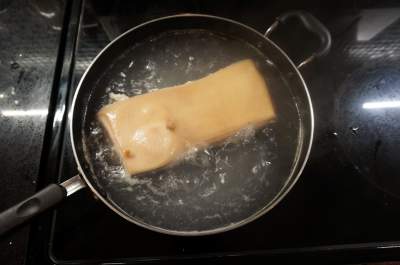
- Rinse the pork and pat dry. Turn pork skin side down. Combine all seasoning ingredients and rub over the meat side of the pork belly. Flip upside down, completely pat dry the skin. Rest in fridge, skin side up and uncovered, for 8 to 12 hours.

- Preheat oven to 400ºF and set oven rack at centre position. Remove pork from fridge. Place a rack on a foil-lined roasting tray to allow for air flow under the pork during cooking. Place pork on rack, insert bamboo skewers diagonally across pork, forming a criss-cross. Cover skin with 1/4 cup coarse salt.

- Place pork in oven and roast for 1 hour. Remove from oven and scrape all the salt off the skin. Turn on the broil function of the oven and reset oven rack to top position.

- Return the pork to the oven to broil. Make sure the skin is no less than 2″ from the top broiler. Watch carefully for 1 to 3 minutes while the skin crisps up. Be careful as it can go from crispy to burned in a matter of seconds.
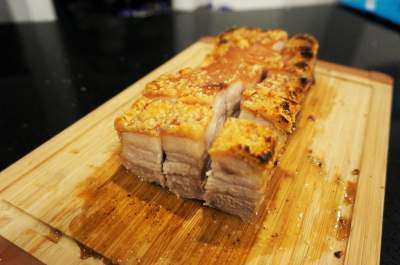
- Pork is cooked when the skin is evenly blistered.

- Cool for 15 minutes, remove skewers, slice with serrated knife, and serve. Optional: dip pieces in white sugar or hoisin sauce before eating.
 euniversal appeal