
恭賀新喜! Happy Chinese New Year! February 8th, 2016 is the first day of the Lunar New Year and marks the start of the Year of the Monkey. Along with the Chinese, a few other Asian groups – Malaysians, Vietnamese, and Koreans, to name a few – also follow the lunar calendar and often have their own Lunar New Year celebration customs. With over 5000 years of history, Chinese New Year is chock full of traditions and superstitions, from auspicious foods, to colourful greetings, to taboo activities that are best avoided unless you want to be on the receiving end of the a disdainful side-eye from an elderly relative.
As a child in Hong Kong, I quite enjoyed Chinese New Years, largely because it was marked by 3 days off from school, plenty of delicious treats, and it was customary for young people to receive red packets (money in red envelopes to ward off evil and bring good luck) and sometimes also new clothes and linen. Since moving to Canada, my family has simplified many of the rituals as there were fewer relatives to visit and no longer the same statutory holidays. In many ways, I prefer this pared down celebration: less mythical hoopla, more time eating and bonding with loved ones.
With out-of-town friends visiting this year, I took the opportunity to host my very first Chinese New Years celebration. Not being particularly superstitious, I ignored the rule against shampooing my hair on New Years Day, which is believed to wash away one’s good fortune. I did, however, honour the tradition of deep-cleaning my house 3 days before the holiday, though it was less to remove stale energy and more to be a respectably hygienic host. I prepared a number of traditional dishes and friends contributed others to round out the meal. Most Chinese New Year foods are steeped in symbolism and homonymous wordplay. (My love for puns and food may also contribute to why I love this holiday.) I’ll discuss some of what we had this year, with Mandarin/Cantonese pronunciations included since they often appear in shops under different names.
- 年糕 (nian gao/neen goh) – sweet glutinous rice cake: This sticky-sweet treat is pretty much the go-to confection of Chinese New Year. “Nian/nin” means “year” while “gao/goh” means “cake” and is a homonym for “raising higher.” Eating this symbolizes the desire to reach new heights. (At 5-feet tall on a generous day, this was obviously my favourite growing up.) The distinct chewy texture comes from its main ingredient, glutinous rice flour, which is actually gluten-free despite the misleading name. The most traditional style is sweetened with Chinese brown sugar bars that give the cake a warm amber appearance, but a version made with white sugar and coconut milk is also fairly common. Usually the batter is steamed until the cake is fully cooked, then the cooled cake is sliced into small pieces, lightly coated in an egg wash, and pan fried before serving. I prefer the coconut style and made one this year stained with pandan extract.

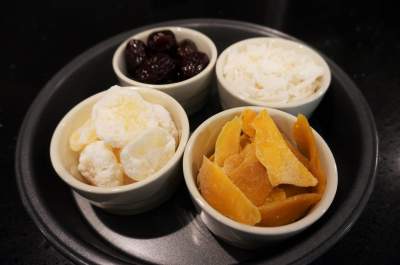
- 全盒 (quanhe/chuenhap) – tray of togetherness: This is basically a fancy candy tray. When guests visit during Chinese New Year, it is customary for the host to present them with this collection of nibbles. Trays often contain an auspicious number of compartments (3 for liveliness, 6 for longevity, 8 for prosperity, or 9 for sufficiency/abundance). Typically it is filled with candied fruits and nuts that each carry their own meaning (e.g. peanuts for good health, roasted melon seeds for fertility, coconut for togetherness). Being a bit lazy, I simply filled a round tray with ramekins of dates, sweetened coconut, dried mangoes, and candied water chestnuts, and ignored the supposed bad luck of having 4 (a word that sounds like “death” in Chinese) containers.
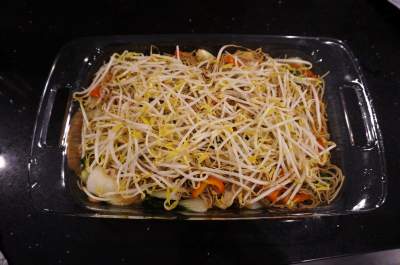
- 麵 (mian/meen) – noodles: A staple at most Chinese birthdays, weddings, and holidays, noodles signify longevity: The longer the strands, the better. Customs vary by region, though wheat noodles are usually more popular than the rice variety for celebrations. They are prepared in many styles: deep fried, braised, soup, or stir fried are all common. Because of the symbolism, it is considered bad luck to intentionally cut the noodles when dishing out portions to serve.
- 魚 (yu/yoo) – fish: A homonym with “having an abundance” or “having resources remaining,” fish is a very standard item on a Chinese New Year menu. To signal the freshness of the ingredient (an important consideration in Cantonese cooking) and the idea of togetherness, it is preferred that the fish be served whole – deep fried, or in this case, steamed with sweet soy sauce, ginger, cilantro, and green onions.

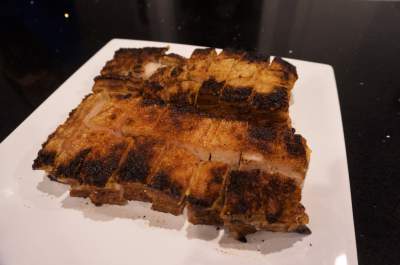
- 燒肉 (shao ruo/siu yuk) – crispy roast pork belly: Way back when meat was an expensive luxury, fatty cuts were considered especially desirable because of the energy they offered. Today, it is common to have a fatty meat as part of a Chinese New Year meal to signify prosperity. This is available at Chinese barbecue shops, but making it at home is also quite simple.
- 糯米飯 (nuomi fan/law mai fan) – fried sticky rice: China has 19% of the world’s population but accounts for 29% of the world’s rice consumption. It is no surprise that a crop this important to the culture makes an appearance on the Chinese New Year table. Fried sticky rice is a hearty dish, studded with dried shitake mushrooms, dried scallops, eggs, and cured sausage to symbolize prosperity.

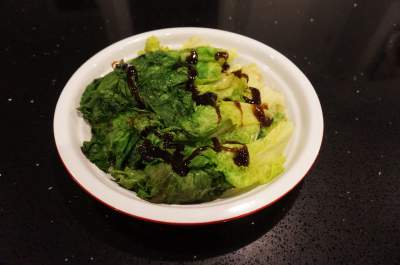
- 生菜 (sheng cai/sang choi) – lettuce: Often dressed in oyster sauce, “sheng/sang” sounds like “to make” and “cai/choi” sounds like “wealth.” Raw vegetables rarely appear in Cantonese cuisine, so the lettuce is typically stir fried or lightly boiled until tender-crisp. Sometimes other leafy greens, which is pronounced cai/choi, are served in place of lettuce to maintain the symbol of wealth.
This list is, of course, incomprehensive. Every region of China has its local traditions and delicacies, and I can only speak from my familiarity with the Cantonese ones. Do you have favourite Lunar New Year dishes or rituals? Or if it isn’t a holiday you celebrate, which customs have you observed that you find most interesting or curious?
 euniversal appeal