
I’m celebrating Valentine’s Day with someone who understands my twisted sense of humour and who is the master of the un-romance. Our first February 14th together, he took me to dinner at an esteemed restaurant with over 6 decades of history and educated me on the virtues of the McGangbang. For another year, he got me this beautiful flower:

So this year, I thought to make the occasion memorable by giving him…crabs. Well, Singaporean chilli crab.
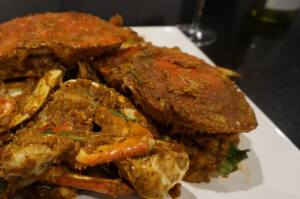
This was one hell of a fragrant, punchy recipe. It really leaned on aromatics – garlic, ginger, onion, and bird’s eye chillis – to give the tomato-based sauce a solid kick, then rounded the corner to knock you in the taste buds again with sambal oelek, a sharp chilli- and vinegar-based Indonesian condiment. In fact, as the sauce was cooking, the air in the kitchen got so spicy that we spent a good 15 minutes in minor coughing fits (another mark of true un-romance) and clearing our sinuses before sitting down to eat. But the flavour? Out of this world! If you make it, make sure you have plenty of steamed rice or mantou to mop up the sauce. If you have sauce leftover, save it for cooking eggplant. The sponginess of the nightshade vegetable makes for the perfect Savoury-Fiery Dinner (the Remix).
To be frank, this dish was chosen for our Valentine’s dinner for reasons beyond the fact that it made for a cheesy pun. Growing up in coastal cities in Asia and North America, I have always loved seafood. Now that I live in the mountains, I try to fit as much seafood in my diet as time and budget allow, for nutrition and gastronomic reasons. Spicy food is also considered to be an aphrodisiac in some circles. Let’s explore the science of that a little bit.
We are able to perceive “hot” (as in taste, not temperature) foods because of VR1 receptors in our mouth. These receptors, located in our skin and mouth, are evolved to actually detect heat (as in temperature) to protect us from touching and eating things that could badly burn us. When capsaicin, the active ingredient in spicy foods, touches our mouth or skin, it binds to the thermoreceptors, depolarizes the sensory neurons, and the signals to our brain, “HOT” and “PAINFUL.” A University of Pennsylvania researcher found that when given a choice of the heat level in food, people tended to indicate a preference for the level just a tiny bit below “unbearable pain.” S0 what gives? It turns out that the human brain’s areas for processing pleasure and aversion overlap closely, both tap into the brain’s dopamine neurons (which shape motivation), and activate similar higher-level cortical areas that influence perceptions and consciousness. The stimulus of spicy food triggers both areas – the fear and arousal from piquant flavours become an acquired taste, similar to people learn to embrace the thrill of horror movies or roller coasters. A small-scale Oxford University cognitive neuroscience study showed that the frontal cortex activity of experiencing relief (after a 5-second, 49ºC “zap” to the arm) overalapped with that of imagining a pleasurable experience like eating a great meal or smelling a relaxing scent. Further, consuming capsaicin often triggers physiological responses like endorphins rush, elevated heart rate, and sweating, which mimic the effects experienced during sex.
So is this recipe a good choice of an aphrodisiac? I’ll leave that for you to decide. Just make sure you brush your teeth and wash your hands thoroughly after eating this if you do decide to do anything with your special someone.
Singaporean Chilli Crab
Ingredients:
- 2 medium live dungeness crabs (about 1.5 lb/680 g each)
- 3 tbsp (45 ml) canola oil
- 1 small onion
- 8 to 12 cloves garlic, finely minced
- 1.5″ (4 cm) ginger, finely minced
- 1 to 6 Thai bird’s eye chilli, sliced (we used 5 for this version)
- 1/2 cup (125 ml) ketchup
- 1 tbsp (30 ml) pure tomato paste
- 2 tbsp (30 ml) soy sauce
- 1 tbsp (15 ml) sambal oelek (optional depending on your heat tolerance)
- 1 tbsp (15 ml) cornstarch
- 1 to 1.5 cups (250 to 375 ml) reduced sodium chicken broth, room temperature
- 1 egg
- 1/4 cup (60 ml) cilantro, roughly chopped (optional)
Directions:
- When buying dungeness crab, try to find the most lively ones. Be careful when picking them from the tank as they may resist. The ones used in this recipe were so full of life that when we brought them home, we were able to stage a crustacean fight just for fun. To make them easier to handle, put the crabs, wrapped in butcher paper and a plastic bag, in the freezer for an hour. The cold will reduce the metabolic rate of the crabs and essentially put them into hibernation mode.

- Rinse the crabs out in the sink.

- To prevent injury, wear thick rubber gloves or clean gardening cloves and use tongs when handling the crabs. Flip one crab onto its back, pull down the tab from its abdomen to expose a cavity, then insert a chopstick through it. Push with firm pressure, wiggling slightly until it slides all the way through the head side.
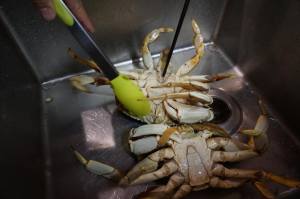
- Hold the crab right side up to allow the brown/black internal fluids to drain out. Repeat with the other crab. Rinse to clean.

- Place crab on a flat surface, belly side up. Insert both thumbs into the abdominal cavity created in Step 3 and pull away to expose the inside of the crab. Remove the gills and separate the legs and claws.
- To prepare the sauce, heat a large skillet or wok to medium-high. Add canola oil and fry the aromatics – onion, ginger, garlic, and chilli – for about 3 to 5 minutes or until the onion becomes translucent.

- While the aromatics are frying, mix together the ketchup, tomato paste, soy sauce, and sambal oelek. Add into the wok and fry for another 2 to 3 minutes.
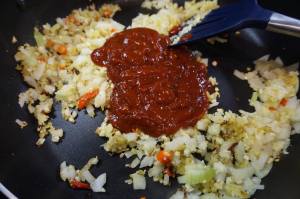
- While the aromatic tomato mix is frying, combine cornstarch with chicken broth. Add into the wok and stir to mix thoroughly.

- The traditional version of the sauce is a bit runnier than the featured here. If you prefer a thinner sauce, increase the chicken broth to 2 cups. Let the sauce simmer for about 5 minutes to thicken slightly, then crack the egg in. Immediately beat it with a fork to break up the yolk, then use a spatula to stir everything together to create an egg drop effect.

- Place separated crab pieces and the body shell into the wok. Gently spoon the sauce over the crab, then cover the wok with a lid. Let steam for about 6 to 7 minutes or until the shells have turned pink. Stir in chopped cilantro if using.
- Transfer the crab pieces onto a platter. Serve immediately with steamed rice or mantou (Chinese steamed buns).

 euniversal appeal